%20250px_edited.png)
澳大利亞塔州中國佛教學院
澳大利亞塔州中國佛教學院
Tasmanian Chinese Buddhist Academy of Australia
Cultural Park
The Tasmanian Chinese Cultural Park of Australia is proposed to be constructed at 1384 Tea Tree Road, Campania, which has a total site area of over a hundred hectares. We believe its magnificent scale and traditional oriental building style will bring vibrant colours and diversity to the local community and to Tasmania, becoming another iconic tourist attraction of Tasmania.
The construction will be completed in different stages. The funding for the construction will come from the donations of worldwide devotees; therefore, depending on the availability of funding, we estimate there will be 10-20 stages over a 200-year period.
The Tasmanian Chinese Cultural Park of Australia is a spiritual gift dedicated to the country and people of Australia from Tasmanian Chinese Buddhist Academy of Australia.

Traditional Chinese Buddhist Culture
Worldwide Buddhist Learning Centre
We believe the Tasmanian Chinese Cultural Park of Australia will improve and bring positive motivation for world peace, economic prosperity and climatic anomalies. Concomitantly, promoting the connection and communication between human and the universe to bring good fortune to mankind.
Our Patriarch Master, Bhagavan Zhi-Ji Vimalakirti applied traditional Chinese geomancy principles and surveyed many places around the world; he discovered a Dragon Energy Spine (a time-space tunnel) at 1384 Tea Tree Road, with its “dragonhead” crouching upon this time- space channel. According to our traditional beliefs, when temples are constructed upon this time-space tunnel and Buddhist Tantric ceremonies are performed, it may help to prevent and avert the heartless havoc of natural calamities.
Traditional Chinese Imperial Court Buddhist Temples are built with unique architectural designs that reflect ideologies of Chinese traditions. The vibrant colours and meticulous designs reflect Chinese people’s understanding of their connection with the heavens.
As a worldwide Buddhist learning and worshipping centre, the Tasmanian Chinese Cultural Park of Australia presents Buddhist history and culture by displaying Buddhist sculptures, statues, architecture, arts, paintings, and images. It is proposed to include modern facilities, including Buddhist museums, a conference hall, auditorium, and multimedia centres in addition to the traditional Sakyamuni Buddha Temple, Maitreya Buddha Temple, Avalokitesvara Buddha Temple, Manjushri Buddha Temple, the Medicine Buddha Temple, scriptural libraries and Relics Stupa.
The Park will be open to worldwide religious practitioners of various schools and traditions, academic scholars and professionals, as well as general tourists, becoming a dynamic cultural, learning and knowledge exchange centre.

First Stage
Tasmanian Chinese Cultural Park of Australia is proposed to have ten main temples with various ancillary facilities and constructions. Majority of the facilities and buildings will showcase the style of traditional Chinese imperial court Buddhist temples. Once finished, it will be the largest Buddhist temple complex in the Southern Hemisphere. It will be a major educational and worship centre for all Holy Tantra Buddhist practitioners.
The First Stage comprises of the Front Gate, Drum Tower and Bell Tower. The Sakyamuni Buddha Temple (the Great Hero Hall) will also be constructed during this stage. Supporting facilities and tourism facilities will be gradually added in line with the overall development progress of the main temple constructions.
As a preliminary start of the first stage of the project, the two Guardian Lions and Four Great Heavenly Devas were installed.
Guardian Lions and Heavenly Devas
As a preliminary start of the first stage of the project, the two Guardian Lions and Four Great Heavenly Devas were installed in 2016. The consecration of stone lion statues at Buddhist temples has the function of protecting and guarding all ten directions, while the Four Great Heavenly Devas are Dharma-protecting deva deities of Buddhism.
Each of the two Guardian Lions are 5.2m high, weigh over 20 tons. Each of the Four Heavenly Devas are 7m high, and weigh 30 tons. They are all made of Chinese white marble.
A pictoral report of the opening can be found here.

Guardian stone lions
This pair of stone lions is identical in style to the Imperial Ritual Bronze Lions of The Forbidden City in Beijing; hence their forms are very calming and majestic.
Stone lions usually sit upon a Sumeru Pedestal Throne, which is covered on top by a brocade mat (this mat covers the Sumeru Pedestal Throne top, with its four corners hanging from the four sides of the Pedestal). In terms of the characteristics of stone lions, they are different in different time periods. Moreover, there are also distinct features that vary according to different geographical regions. The styling of the lions has been modified through embellishment, such that their basic shapes all have a full head of curly mane, and are either sitting or crouching majestically in grandeur.
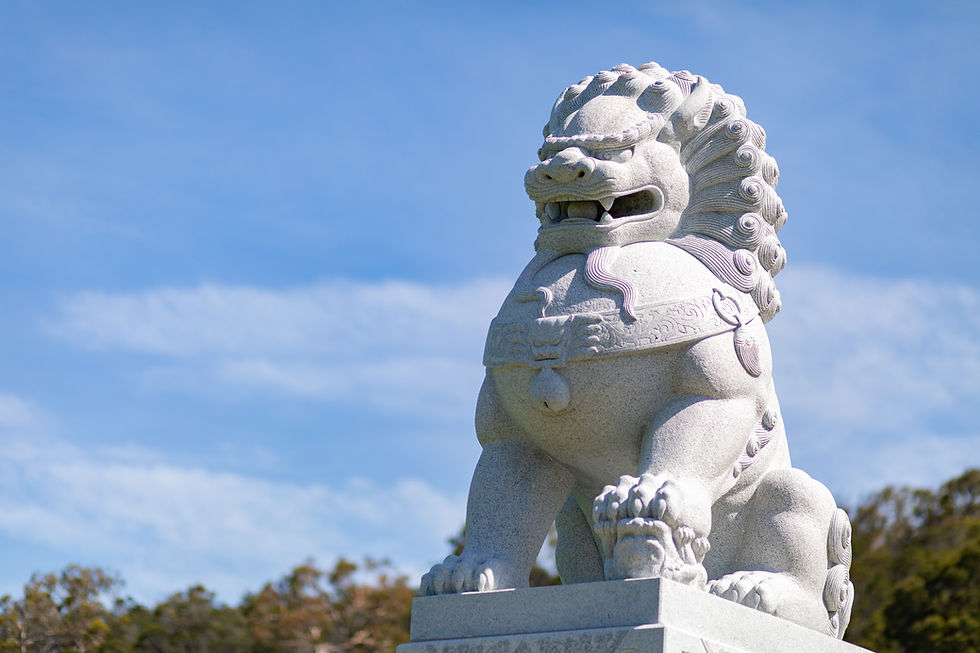
According to Chinese traditional culture, there are strict protocols for the placement of stone lions. These conventions conform to the rules of the unrevealed world of the universe.
In general, stone lions come in a pair, and are placed in accordance to the Chinese traditional Yin-Yang philosophy, where the male is on the left and female is on the right. The male lion usually holds an embroidered ball in his right front paw, while the female lion gently strokes a cub with her left front paw.
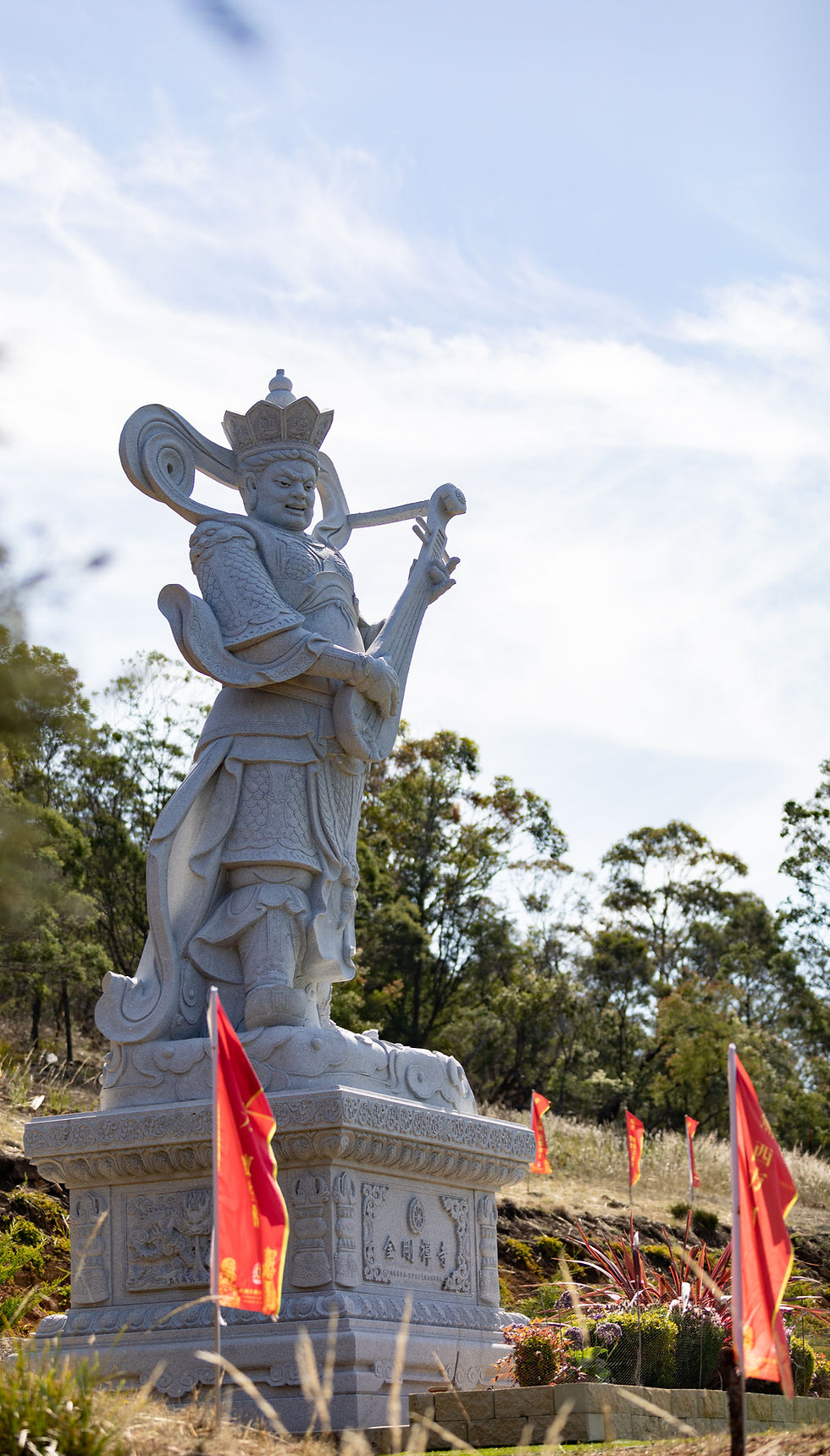
Dhritarastra Holy Statue
'Land Upholding' Eastern Heavenly Deva
'Land Upholding' refers to the heart/mind of kindness and compassion, the protection of sentient beings and the guarding of the nation or land.
He holds a Chinese lute in His hands, signifying that the strings of stringed instruments must be strung with a moderate degree of tightness; a string in tune is neither too tight nor too loose.
This demonstrates that with all matters, one must practice the Dharma of the Middle Way. He is the foremost deity of music, using Dharma music to teach sentient beings.

'Growth' Southern Heavenly Deva
'Growth' refers to educating and guiding sentient beings so as to sever their confusion and terminate their doubt, thus enabling the growth of their virtuous roots.
He wields a treasure sword signifying the sword of wisdom.
This demonstrates using the wisdom of Buddhist Dharma to sever the afflictions of sentient beings’ current and eternal lives, thus allowing sentient beings to transform the Five Poisons into the Five Wisdoms and attain current life benefit.
Virudhaka Holy Statue
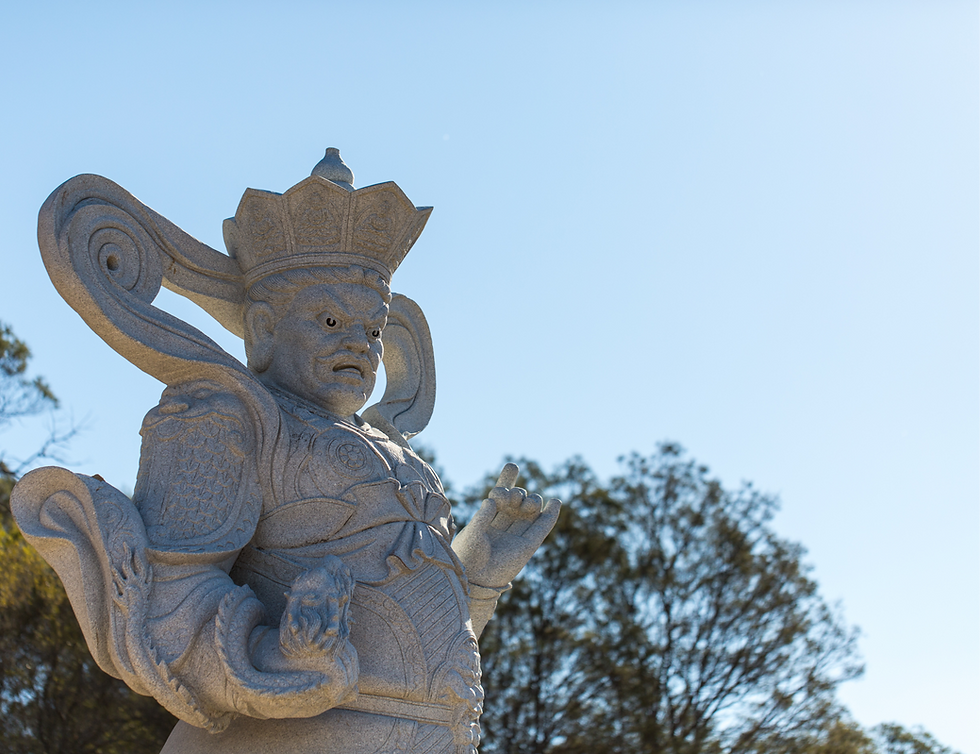
Virupaksa Holy Statue
'Broad Vision' Western Heavenly Deva
'Broad Vision' refers to using pure Heavenly Eyes to observe the entire world in order to protect its citizens, hence named “Broad Vision Heavenly Deva”.
He is the leader of all dragons, a red dragon wraps around His right hand while His left hand grasps a treasure pearl.
The dragon represents change and transformation, and the treasure pearl represents purity and brilliance.
Together, they demonstrate the use of the pure miraculous transformations of Buddhist Dharma to protect the nation, bring good fortune to the populace, and extensively save sentient beings.

Vaisramana Holy Statue
'Well-Informed' Northern Heavenly Deva
This Heavenly Deva incessantly protects the Dharma Hall of the Tathagata and frequently listens to Dharma preaching.
His right hand wields a treasure parasol (also known as a treasure flag), and His left hand holds a deity squirrel – a squirrel that seeks treasure.
The treasure parasol represents the protection of sentient beings from the attack of the negative energies of the Universe, as well as the bestowment of great auspiciousness and immense joy to sentient beings.
The deity mouse represents treasure and wealth; this signifies the protection of citizens’ treasure and wealth, especially the protection of sentient beings’ most precious pure spiritual treasure – the pure Dharma nature of their inner hearts.
